
23 March 2026 · By Matt Gade
Pallet Racking Safety Requirements in Australia: A Complete Guide

Every employer operating a warehouse in Australia has a legal obligation to ensure their pallet racking is safe, properly maintained, and compliant with current standards. The primary standard governing pallet racking design, installation, and use is AS 4084:2023 — Steel Storage Racking.
This guide explains the key safety requirements, inspection obligations, and practical steps warehouse operators in Queensland and New South Wales should follow.
What Is AS 4084:2023?
AS 4084:2023 is the Australian Standard that sets out the requirements for the design, manufacture, and installation of steel storage racking used in commercial and industrial environments. It replaced the earlier AS 4084:2012 edition and introduced updated requirements for load signage, inspection frequency, and damage assessment. You can view the standard through Standards Australia.
The standard applies to all adjustable pallet racking, selective racking, drive-in racking, cantilever racking, and similar storage systems used in warehouses, distribution centres, and cold-storage facilities across Australia.
Employer Obligations Under WHS Laws
Under the Work Health and Safety Act 2011, employers must eliminate or minimise risks to workers. Both Workplace Health and Safety Queensland and SafeWork NSW enforce these obligations. This includes ensuring racking systems are:
- Designed and installed to AS 4084:2023 standards
- Regularly inspected by competent personnel through professional racking audits
- Promptly repaired when damage is identified
- Fitted with correct Safe Working Load (SWL) signage
- Not loaded beyond their rated capacity
Failure to comply can result in significant penalties, improvement notices, and — in the event of an accident — prosecution under WHS legislation. For more information on workplace safety obligations, visit Safe Work Australia.
Inspection Requirements
Formal Expert Audits
AS 4084:2023 recommends that all pallet racking systems receive a formal expert inspection at least every 12 months. These audits should be conducted by a qualified racking inspector who assesses every component for damage, deflection, corrosion, and compliance.
The result is a detailed report — typically colour-coded (Green / Amber / Red) — that prioritises repairs by risk level. Red-rated items require immediate action, including unloading and isolating the affected bay.
Routine In-House Checks
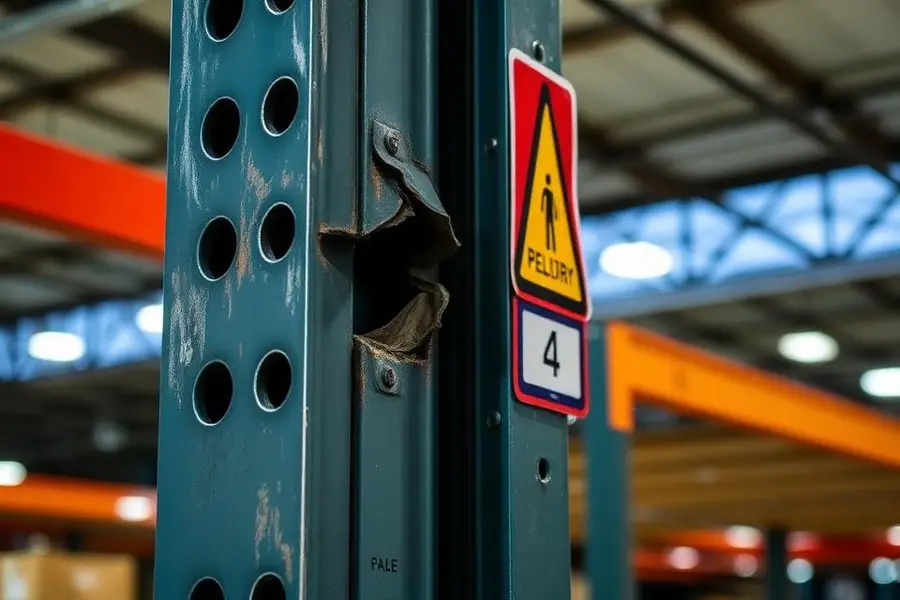
Between formal audits, warehouse staff should conduct regular visual inspections — weekly or monthly depending on traffic levels. These checks look for obvious signs of damage such as bent uprights, displaced beams, missing safety clips, and overloaded bays. A structured maintenance program helps ensure nothing is overlooked.
Common Racking Safety Issues
- Damaged uprights — bent, buckled, or cracked columns caused by forklift impacts
- Missing safety clips — beam locking pins missing or disengaged
- Overloading — exceeding the rated SWL per beam level or bay
- Incorrect load signage — missing, illegible, or outdated SWL labels
- Poor anchoring — base plates not bolted to the floor or anchor bolts loose
- Corrosion — especially in cold storage, outdoor, and high-humidity environments
How to Stay Compliant
- Schedule annual professional racking audits with a qualified inspector
- Implement a regular in-house visual inspection program
- Repair or replace damaged components promptly — never ignore Red-rated damage
- Ensure SWL signage is displayed on every row and updated after any configuration changes
- Train forklift operators and warehouse staff on racking safety protocols
- Keep records of all inspections, audits, and repairs
Need a Professional Racking Audit?
Pallet Racking Maintenance provides comprehensive AS 4084:2023 compliant racking audits across Queensland and New South Wales. Our QBCC licensed team has over 20 years of experience inspecting, repairing, and maintaining pallet racking systems for warehouses of all sizes.