Mode 1
Upright damage — front-to-back lean
The most common AS 4084 finding in Australian warehouses. Measured by hanging a plumb line down the front column and noting deflection from vertical at the top of the frame.
- Green: ≤3 mm per metre of upright height.
- Amber: 3–5 mm per metre — schedule repair within 28 days.
- Red: >5 mm per metre — unload and isolate immediately.
- Always check both front-to-back AND side-to-side.
Mode 2
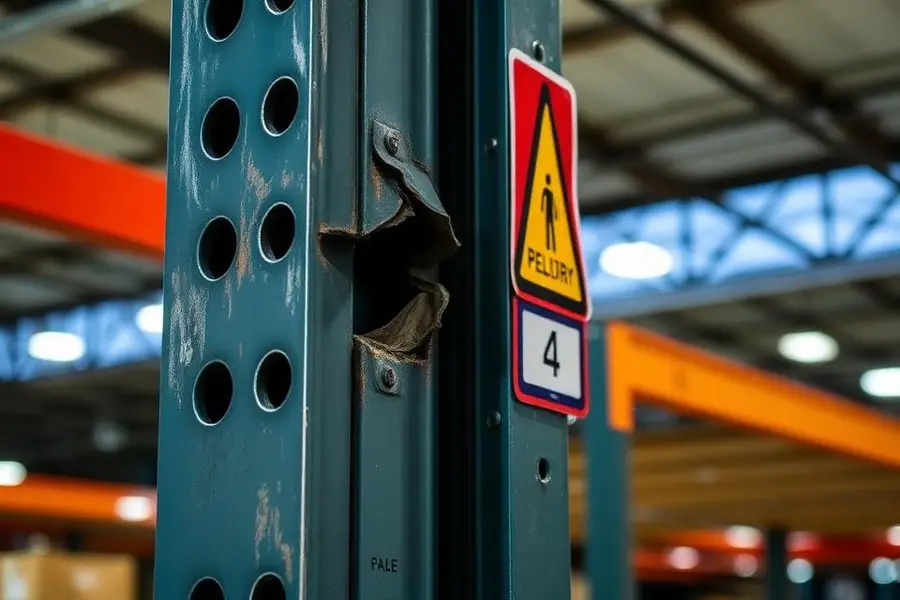
Upright damage — fork-tip dents and bows
Localised damage in the bottom 1m of the front column, almost always caused by forklift contact during pallet placement or retrieval. Bows are measured with a 1m straight edge.
Mode 3
Beam damage — deflection and twist
Beams are designed to flex under load — but only within the L/200 limit. Permanent set (sag remaining after unloading) is an instant Red finding. Twist or rotation in the beam end is also Red.
| Symptom | Rating | Action |
|---|---|---|
| Deflection ≤L/200 under load | Green | Monitor |
| Deflection L/200–L/180 under load | Amber | Reduce load, schedule repair |
| Deflection >L/180 OR permanent set | Red | Unload, replace beam |
| Beam end twist or connector lift | Red | Unload, replace |
Mode 4
Baseplate and anchor damage
The baseplate is the only thing transferring load to the slab. Any gap, missing anchor, lifted plate or visible slab spalling triggers a Red rating because the entire frame is compromised — not just one bay.
Mode 5
Bracing damage
Horizontal and diagonal bracing distributes load between the two columns of a frame. Bent, missing or fractured bracing forces the columns to act independently, which is a structural design no engineer would ever sign off on.
Often missed
Modes 6 & 7
Connector wear and corrosion
Beam-to-upright connectors wear with repeated loading. Look for elongation in the slot, missing safety pins and movement when the beam is rocked. Corrosion is rated separately — surface rust is Green, pitting is Amber and section loss is Red.