
Why it matters
The base carries everything
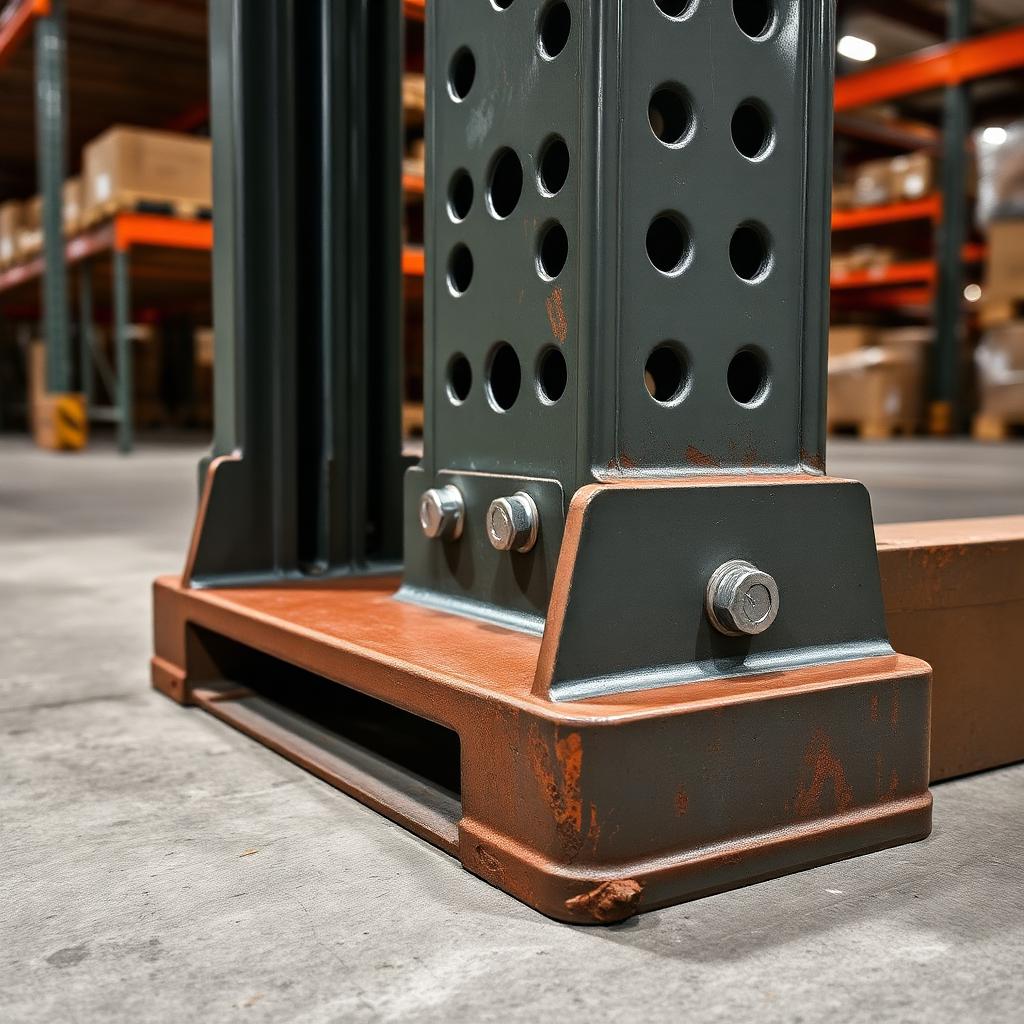
The baseplate transfers every pallet, every beam and every bay-load above it into the concrete slab. The anchors stop the upright from kicking out under lateral load — forklift nudge, accidental sideswipe, pallet overhang. Without functional anchors, the frame is relying on gravity and bracing alone, and a single side-impact can fold the whole run.
Floor-level inspection is non-negotiable
What to check
The five-point base inspection
At every monthly internal inspection, a competent person should walk the line and check each baseplate. The whole job for a 50-bay run takes about 15 minutes.
- Anchor count — every upright has the manufacturer's specified number of anchors fitted.
- Anchor torque — a spanner check confirms the nut is tight; loose anchors are tagged.
- Baseplate condition — no cracks, no distortion, no peeled-up corner.
- Concrete slab — no cracks radiating from any anchor hole, no spalling under the plate.
- Corrosion — no flaking rust, no white salt deposits (cold storage), no concrete softening.
Failure modes
What each failure tells you
| Symptom | Likely cause | AS 4084 rating | Action |
|---|---|---|---|
| One missing anchor | Forklift impact tore it loose, or never installed | Amber | Re-anchor within 7 days |
| All anchors loose to hand | Wrong anchor for slab type, or vibration loosening | Red | Isolate, engineering review |
| Cracked baseplate | Heavy impact or fatigue from impact cycles | Red | Replace upright section |
| Slab spalling at anchor | Edge-distance too small, or chemical anchor required | Red | Engineering review before re-anchoring |
| Visible rust through paint | Wash-down area or cold-store condensation | Amber | Clean, paint, monitor; replace if section loss |
Re-anchoring done right
How a compliant re-anchor actually goes
Re-anchoring looks like a five-minute job. Done badly, it sets up the next failure. The compliant version follows manufacturer geometry exactly.
- Identify the anchor specification from the original installer or manufacturer documentation.
- Confirm the slab thickness and condition with a sample core or hammer test.
- Drill new holes at the manufacturer's edge distance from any existing hole, anchor and slab edge.
- Vacuum the holes clean before setting any anchor — bond strength depends on it.
- Install resin or expansion anchors per the manufacturer's torque spec.
- Record location, anchor type, batch and torque on the inspection report.
Hot-spots
Where base damage concentrates
Across the warehouses we inspect in Queensland and New South Wales, base-level damage clusters in predictable places: end-of-row uprights in high-throughput selective racking, drive-in entry frames, cold-storage frames within a metre of the door, and any frame next to a forklift battery-charging station. If your site has any of these, double the inspection frequency at the base.