
What bracing does
The role of bracing in a racking frame
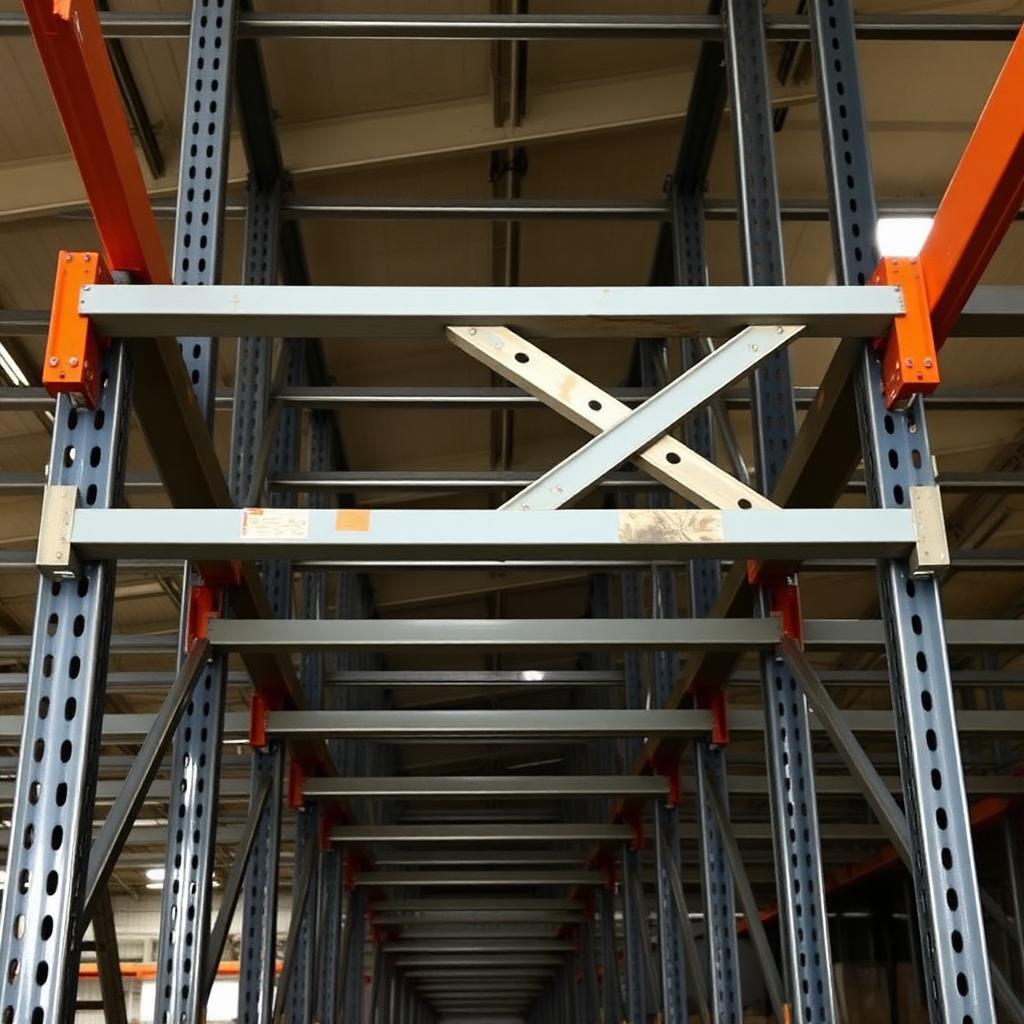
A pallet racking frame is two uprights tied together with horizontal and diagonal bracing. The uprights carry the vertical load; the bracing keeps the uprights aligned and resists lateral movement. Without intact bracing, each upright is effectively a free-standing column — and free-standing columns fold sideways the moment they're nudged.
| Brace type | What it does | What damages it |
|---|---|---|
| Horizontal brace | Ties the upright pair to the same vertical plane | Forklift tine on the way out of a low pick |
| Diagonal brace (front-to-back) | Resists fore-aft sway under load and impact | Side-impact from a forklift turning into the aisle |
| Spacer / plan brace | Maintains frame depth at floor level | Pallet overhang dragging across the brace |
| Bottom brace (knee brace) | Stiffens the lower 600 mm where impacts concentrate | Fork-tip strikes during pallet placement |
Why it spreads
The cascade — how one damaged brace becomes three
Bracing is a load-sharing system. The frame's published capacity assumes every brace is in place and undamaged. When one brace bends, the load it was carrying redistributes to the adjacent members — which were never designed to carry the extra share. Over weeks of normal operation, the neighbours fatigue and crack. By the time the second brace fails visibly, the third is already partly compromised.
The 24-hour rule
How to inspect
The frame-by-frame brace check
Brace inspection is a five-minute job per frame. Done monthly across a 100-frame run, it's about a day's work — and it catches almost every brace failure before it becomes a Red rating.
- Walk to the end of the run and sight down each frame from behind — bent braces show as kinks against a straight background.
- Check each brace for visible bend, twist or buckle.
- Confirm both end-bolts are present and tight on every brace.
- Check the connection point for elongated bolt holes (a sign of repeated impact).
- Photograph any non-conformance with a tape measure or marker visible for scale.
- Tag the bay and isolate stock above the damaged section.
Decision tree
What each finding means
| Finding | AS 4084 rating | Action |
|---|---|---|
| Paint scuff, no deformation | Green | Log; recheck at next inspection |
| Visible bend under 10 mm out of plane | Amber | Off-load top beam, replace within 4 weeks |
| Bend over 10 mm, buckle or missing bolt | Red | Stop work, off-load bay, replace before re-use |
| Brace missing entirely | Red | Stop work, off-load bay, source manufacturer-original replacement |
| Elongated bolt holes at connection | Amber | Replace brace and check upright drilling for damage |
Hot-spots
Where brace damage concentrates
Three places account for most brace damage we see at Queensland and New South Wales sites: end-of-row frames in selective racking aisles, knee braces in drive-in racking entry frames, and any frame within two bays of a turning circle where forklifts pivot. End-of-row bollards and column guards substantially reduce the rate — they're cheap insurance against an expensive cascade.